SIGGRAPH 2026 Talk- Path Guiding in Disney's "Zootopia 2"
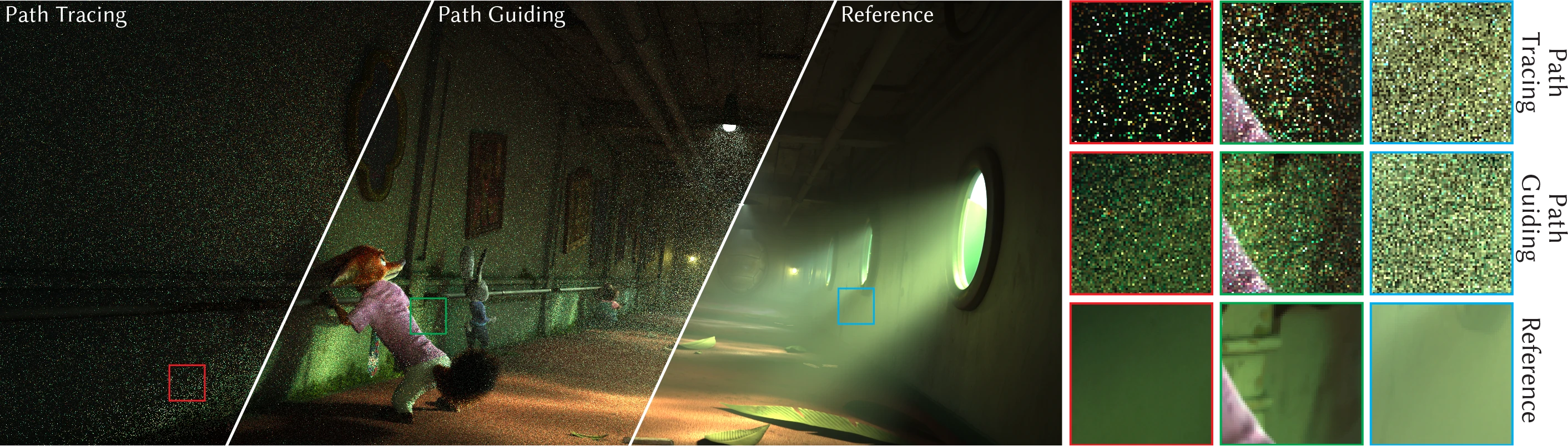
Last year at SIGGRAPH 2025, the Hyperion team from Disney Animation and the rendering research group at DisneyResearch|Studios presented our work developing Hyperion’s second-generation path guiding system for surfaces and volumes [Reichardt et al 2025], built on top of OpenPGL [Herholz and Dittebrandt 2022]. At SIGGRAPH 2026, we have a talk that serves as a followup to last year’s course; our talk this year is about how we used our second-generation path guiding system for the first time on Zootopia 2. This talk contains several additional production-motivated improvements on top of what we presented last year, and goes through some concrete examples and data from Zootopia 2.
Lea Reichardt and I are presenting the talk together at SIGGRAPH 2026 in Los Angeles as part of the “Rendering and Volumes” session on Thursday, July 23rd.
Here is the paper abstract:
Walt Disney Animation Studios’ “Zootopia 2” was the first film to make extensive use of Disney’s Hyperion Renderer’s [Burley et al. 2018] second-generation path guiding system, built on top of OpenPGL [Herholz and Dittebrandt 2022]. Jumping from initial implementation to at-scale production usage required us to solve additional practical problems on top of what we previously described in Reichardt et al. [2025]. We introduce two new methods: one for estimating the efficiency improvement path guiding gives over path tracing without the need for multiple long comparison renders, and one for allowing path guided results to match sources of bias common in production rendering introduced by common practical variance-reduction techniques. We also describe improvements to our radiance recorder mechanism. Finally, we will examine how our path guiding system was used on “Zootopia 2”, including artist experiences, complex and difficult scenes that path guiding enabled more efficient renders and better workflows on, and general lessons learned.
The paper and related materials can be found at:
As usual, I’ve put all of the relevant paper materials on the project page, and this blog post is some additional personal notes that offer up my perspective on the project but isn’t necessary for understanding the technical details of the project.
An interesting quirk about how Disney Animation’s typically November-release-focused production cycle lines up with SIGGRAPH is that the work we present at SIGGRAPH often lags very far behind what we are actively working on. Usually the work we present at SIGGRAPH would have been completed at least a full year ago, often around the time of the previous SIGGRAPH or earlier. This is because in order to complete a film by November of each year, major technology development will have had to be wrapped up several months earlier, which means sometime in the summer, but we don’t present the work until the SIGGRAPH after the film is completed, which means waiting until the next summer.
In the case of this talk and our path guiding course last year, what this timeline means is that most of the work presented in this talk was actually underway while we were presenting the course last year, and the material presented in that course had been completed two years ago before this summer, during the production of Moana 2. So, around the same time that we presented the course last year, behind the scenes we were simultaneously working on all three of the improvements presented in this talk. The throughput clamp compensation mechanism was developed by Alexander Rath and productionized by Lea Reichardt, while the efficiency estimate mechanism was invented and prototyped by Marco Manzi and then I reworked it into the final production version and worked with Neelima Karanam to build out artist tooling around the efficiency estimate system. While both of these projects were going on, Brian Green was developing the Radiance Recorder improvements.
As I wrote in my post about last year’s course, this project has been one of my all-time favorite projects I’ve worked on because of the way this project has spanned all the way from pure research with our peers at DisneyResearch|Studios to full production deployment on Zootopia 2, in close collaboration with Zootopia 2’s TD and lighting departments. Being able to see a large collaborative project through from an abstract research idea all the way through to final pixels in a completed film is extraordinarily gratifying; it really exemplifies how what we do is a fusion of really cool technology with really amazing art. For me, seeing our path guiding system used on large swaths of Zootopia 2 is even more satisfying because the road to getting some form of path guiding to a point where it truly is practical for production is a journey that goes even further back than the current incarnation of this project. The current incarnation of this project was in a lot of ways born out of addressing the shortcomings of our first generation path guiding attempt, which dates all the way back to the early production of Frozen 2 some eight years ago and, despite some occasional limited usage, never achieved widespread adoption or applicability.
I think seeing the sheer number of things that had to come together in order for this project to be successful is also pretty amazing. We were very fortunate to have Alexander Rath join DisneyResearch|Studios and take an interest in this project; his contributions have been critical to the project and he brought key ideas such as efficiency-awareness [Rath et al. 2022] to the project. We’re also very fortunate to have the Disney Research deep-learning denoiser project [Vogels et al. 2018, Dahlberg et al. 2019] available to us; the efficiency estimate mechanism depends on having a really fast, really good denoiser to provide ground truth proxies, and luckily we had one already in production use! We were also very fortunate to have studio leadership that understands the value of close research collaboration and greenlit us folding the DisneyResearch|Studios team directly into our internal studio development environment, allowing them to use and edit Hyperion directly as a research platform and test directly on real production data. Furthermore, seeing how the success of this project is already spawning more cool research in related areas is also really interesting. Now that we have a robust and complete framework in place in Hyperion to facilitate path guiding, the DisneyResearch|Studios team has already begun experimenting with extending the framework for even more advanced approaches to guiding, such as neural guiding with asynchronous GPU training [Rath et al. 2025]. The Radiance Recorder has also proven to be a super valuable data structure not just for path guiding, but in general for collecting path data for other purposes. As an example, the Neural Render Proxies project [Sancho et al. 2026] that DisneyResearch|Studios presented at EGSR this year is built directly on top of the Radiance Recorder framework.
One of the most impactful lessons I learned from this project is the importance of not just partnering with production on ambitious research projects, but making sure that they are involved and are able to provide input and a production perspective early in the research process. In the case of Zootopia 2, we brought the show’s TD and lighting leadership up to speed on the project very early in both the project’s existence and in the show’s production. Because the show was involved early in the project, their confidence in the project grew as we made progress, and by the time we had everything ready to go on the research and development side, the show trusted that we knew what we were doing and that the project would be beneficial to the show. Addressing the show’s concerns and needs was built into the development process from the start, instead of being treated as an afterthought.
Here is an example of how the trust and partnership between the research team, the Hyperion development team, and the show’s leadership worked. One of the early test Zootopia 2 shots we were evaluating path guiding on was the “Gala” scene that we show as a failure case in the talk’s expanded results. The chandelier in that shot proved to be an interesting case; even though guiding did not help improve overall efficiency on this shot, lighters noticed early on that guiding did provide a visual benefit. The chandeliers in the scene are made up of thousands of refractive glass elements with dispersion, which casts a ton of internal caustics, which Hyperion’s main unidirectional path tracing code path cannot handle well. As a result, Hyperion usually clamps away most of the fireflies this type of case causes, but path guiding allowed the renderer to better learn how to sample this case and have it converge to a brighter, more colorful, less biased result compared to the standard renderer. Our artists actually really liked this effect, despite it not matching the approved art direction for the shot. This finding both helped motivate the clamping compensation work in order to meet the show’s already-approved art direction, but also helped motivate a larger re-evaluation of the need for throughput clamping in the modern renderer, and this re-evaluation eventually led us to conclude that we could remove throughput clamping entirely for future shows and instead depend on a combination of path guiding and our deep learning denoiser to reduce fireflies. Early evaluation and testing from artists both helped shape the version of the system that we used on Zootopia 2 and tailor it to Zootopia 2’s needs, but also helped us revisit and reshape another part of the renderer to benefit all future shows.
An added bonus of the show being looped into the project early is that they got a front-row seat to what the DisneyResearch|Studios team did and therefore were able to better appreciate how crucial the DisneyResearch|Studios contribution to the project was. As a result, Marios Papas and Marco Manzi were given credits on Zootopia 2 in recognition of their leadership and work on the project from the beginning. I hope we get to do a lot more of this on future shows!
One last note: OpenPGL was recently accepted by the Academy Software Foundation as an official ASWF project, which is fantastic news. Becoming an ASWF project guarantees that OpenPGL has a long and bright future ahead of it and will see continued long-term development and support. From what I’ve heard from Sebastian Herholz and from friends more involved with ASWF governance matters, our use of OpenPGL as the basis of our second-generation path guiding system on Zootopia 2 was a large factor in convincing the ASWF of OpenPGL’s real-world production readiness and suitability as a ASWF project. I’m sure Zootopia 2 was just one of several major convincing data points, but I’m very glad to hear that we played some role in helping convince the ASWF!
References
Brent Burley, David Adler, Matt Jen-Yuan Chiang, Hank Driskill, Ralf Habel, Patrick Kelly, Peter Kutz, Yining Karl Li, and Daniel Teece. 2018. The Design and Evolution of Disney’s Hyperion Renderer. ACM Transactions on Graphics 37, 3 (Jul. 2018), Article 33.
Henrik Dahlberg, David Adler, and Jeremy Newlin. 2019. Machine-Learning Denoising in Feature Film Production. In ACM SIGGRAPH 2019 Talks. Article 21.
Sebastian Herholz and Addis Dittebrandt. 2022. Intel® Open Path Guiding Library.
Alexander Rath, Pascal Grittman, Sebastian Herholz, Philippe Weier, and Philipp Slusallek. 2022. EARS: Efficiency-Aware Russian Roulette and Splitting. ACM Transactions on Graphics (Proc. of SIGGRAPH) 41, 4 (Jul. 2022), Article 81.
Alexander Rath, Marco Manzi, Farnood Salehi, Sebastian Weiss, Tiziano Portenier, Saeed Hadadan, and Marios Papas. 2025. Neural Resampling with Optimized Candidate Allocation. In Proc. of Eurographics Symposium on Rendering (EGSR 2025). Article 20251181.
Lea Reichardt, Brian Green, Yining Karl Li, and Marco Manzi. 2025. Path Guiding Surfaces and Volumes in Disney’s Hyperion Renderer- A Case Study. In ACM SIGGRAPH 2025 Course Notes: Path Guiding in Production and Recent Advancements. 30-66.
Sergio Sancho, Alexander Rath, Marco Manzi, Pascal Chang, Amit Bermano, Derek Nowrouzezahrai, Markus Gross, and Marios Papas. 2026. Neural Render Proxies for Interactive and Differentiable Lighting. Computer Graphics Forum (Proc. of Eurographics Symposium on Rendering) 45, 4 (Jul. 2026), Article e70533.
Thijs Vogels, Fabrice Rousselle, Brian McWilliams, Gerhard Röthlin, Alex Harvill, David Adler, Mark Meyer, and Jan Novák. 2018. Denoising with Kernel Prediction and Asymmetric Loss Functions. ACM Transactions on Graphics (Proc. of SIGGRAPH) 37, 4 (Aug. 2018), Article 124.